


HOUSING CHOICE
( is )
ABUNDANT
( Lower costs by making more homes legal and buildable. )
UNSUBSIDIZED
( Workforce housing without federal subsidies, preserving essential public resources. )
ATTAINABLE
( Feasible to build and realistically affordable for residents. )
RESPONSIBLE
( Built near existing infrastructure to protect land and cut travel. )
HOUSING CHOICE
ABUNDANT
( Lower costs by making more homes legal and buildable. )
UNSUBSIDIZED
( Workforce housing without federal subsidies, preserving essential public resources. )
ATTAINABLE
( Feasible to build and realistically affordable for residents. )
RESPONSIBLE
( Built near existing infrastructure to protect land and cut travel. )
HOUSING CHOICE
( is )
WHAT IS HOUSING CHOICE?
Housing choice is about expanding what kinds of homes can be built, where they can be built, and who they can serve.
By focusing on feasible, unsubsidized homes near existing infrastructure, it lowers costs and creates realistic paths to ownership in established communities.
WHAT IS HOUSING CHOICE?
Example Definition: Housing choice is about expanding what kinds of homes can be built, where they can be built, and who they can serve.
By focusing on feasible, unsubsidized homes near existing infrastructure, it lowers costs and creates realistic paths to ownership or attainable rentals in established communities.
HOUSING MISMATCH
The United States is suffering from a housing mismatch.
We have an oversupply of large single family homes,
and a deficit of small format housing choices, causing prices to soar. While some of this can be attributed to zoning codes constraining supply, much can also be said for transformative demographic shifts.
LIVING SPACE PER PERSON
1058 SQ.FT.
2024
1950
292 SQ.FT.
2024
1058 SQ.FT.
1950
292 SQ.FT.
THE CHALLENGES
LIVING SPACE PER PERSON
- SOURCE
In 1960, 56% of American households were not traditional nuclear families, by 2023 number rose to 82%
13%
30%
44%
8%
4%

29%
29%
16%
7%
18%
1960
2023
However,
72% of American house units still cater to nuclear families.

A DECLINE OF HOMES UNDER 1,400 SF
The average home today provides over 1,000 SF of living space per person; this is 3.5x the amount of living space per person provided a few generations ago. This increase in home sizes directly correlates to increases in home prices. Further, we have delivered fewer and fewer starter homes (homes less than 1,400 SF) over the past 50 years. Today, less than 10% of homes built are smaller than 1,400 SF, despite the demand.
HOUSING MISMATCH
The United States is suffering from a housing mismatch. We have an oversupply of large single family homes, and a deficit of small format housing choices, causing prices to soar. While some of this can be attributed to zoning codes constraining supply, much can also be said for transformative demographic shifts.
However, 72% of American house units still cater to nuclear families.
LIVING SPACE PER PERSON
1058 SQ.FT.
2024
1950
292 SQ.FT.
The average home today provides over 1,000 SF of living space per person; this is 3.5x the amount of living space per person provided a few generations ago. This increase in home sizes directly correlates to increases in home prices. Further, we have delivered fewer and fewer starter homes (homes less than 1,400 SF) over the past 50 years. Today, less than 10% of homes built are smaller than 1,400 SF, despite the demand.
A DECLINE OF HOMES UNDER 1,400 SF
THE CHALLENGES
2024
1058 SQ.FT.
1950
292 SQ.FT.
In 1960, 56% of American households were not traditional nuclear families, by 2023 number rose to 82%
13%
30%
8%
4%
16%
7%
18%
LIVING SPACE PER PERSON
- sOURCE
1960
2023
THE INCOME LADDER
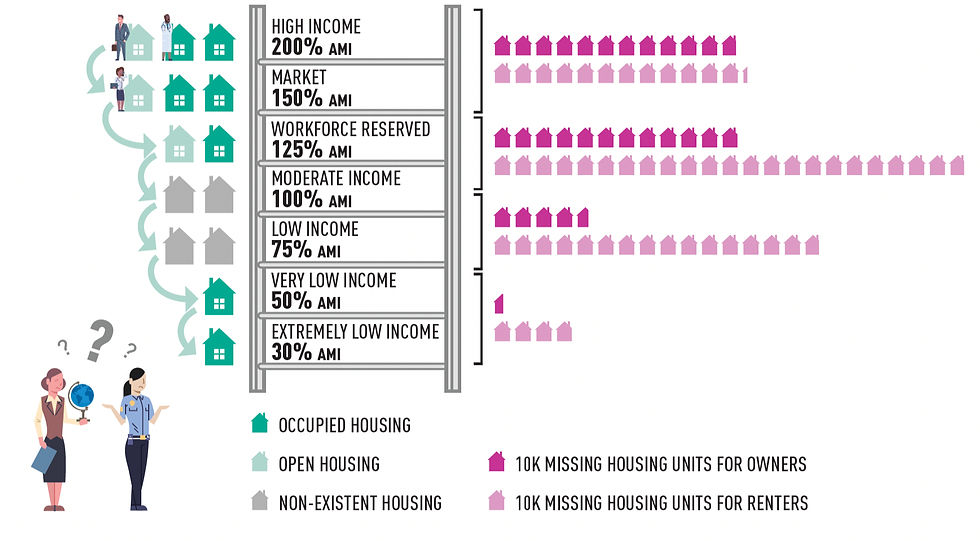
When there aren’t enough homes, everybody competes for what’s available. Those at the highest income levels are forced to buy down the housing ladder into the next most desirable neighborhood. This puts pressure on each successive neighborhood. The largest deficit exists in housing for those between 75-125% Annual Median Income (AMI). The highly limited housing in this band is often bought or rented by those in higher income brackets, leaving those falling into that economic bracket with few if any housing options.

THE INCOME LADDER
When there aren’t enough homes, everybody competes for what’s available. Those at the highest income levels are forced to buy down the housing ladder into the next most desirable neighborhood. This puts pressure on each successive neighborhood. The largest deficit exists in housing for those between 75-125% Annual Median Income (AMI). The highly limited housing in this band is often bought or rented by those in higher income brackets, leaving those falling into that demographic with few if any housing options.
HOUSING LADDER
BUY-DOWN
INCOME LADDER
ESTIMATED HOUSING DEFICIT
UNMET DEMAND
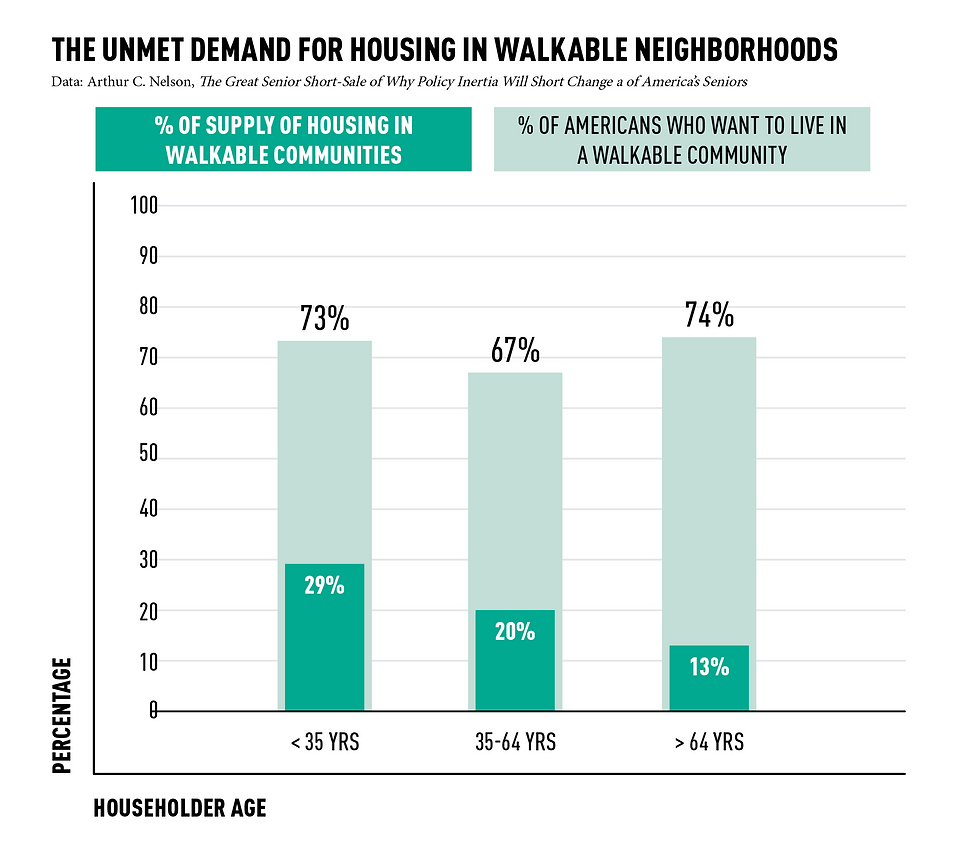
A majority of individuals—across all age groups—want to live in walkable communities. The problem is, less than 10% of housing stock is located in walkable neighborhoods. This creates increased demand for a small amount of neighborhoods, which further drives up home prices in these desirable areas.
We like to say: it’s not a shortage of walkable neighborhoods, but a shortage of housing in walkable neighborhoods.
100%
% OF AMERICANS WHO WANT TO LIVE IN
WALKABLE COMMUNITIES
% OF SUPPLY OF HOUSING IN
WALKABLE COMMUNITIES
73%
29%
< 35 YRS
67%
20%
35 - 64 YRS
74%
13%
35 - 64 YRS
tHE UNMET DEMAND FOR HOUSING IN WALKABLE NEIGHBORHOODS
0%
UNMET DEMAND
A majority of individuals—across all age groups—want to live in walkable communities. The problem is, less than 10% of housing stock is located in walkable neighborhoods. This creates increased demand for a small amount of neighborhoods, which further drives up home prices in these desirable areas.
We like to say: it’s not a shortage of walkable neighborhoods, but a shortage of housing in walkable neighborhoods.
100%
tHE UNMET DEMAND FOR HOUSING IN WALKABLE NEIGHBORHOODS
0%
% OF SUPPLY OF HOUSING IN
WALKABLE COMMUNITIES
% OF AMERICANS WHO WANT TO LIVE IN
WALKABLE COMMUNITIES
67%
20%
35 - 64 YRS
74%
13%
35 - 64 YRS
73%
29%
< 35 YRS
UNMET DEMAND
A majority of individuals—across all age groups—want to live in walkable communities. The problem is, less than 10% of housing stock is located in walkable neighborhoods. This creates increased demand for a small amount of neighborhoods, which further drives up home prices in these desirable areas.
We like to say: it’s not a shortage of walkable neighborhoods, but a shortage of housing in walkable neighborhoods.

We have an oversupply of large single family homes, and a deficit of small format housing choices.
We need to build more housing that matches our current needs:
SMALL, ATTAINABLE, AND IN WALKABLE NEIGHBORHOODS
SMALL, ATTAINABLE, AND IN WALKABLE NEIGHBORHOODS

THE VARIABLES
Understanding the distinction between the IRC and IBC is crucial for creating successful, responsible, and attainable housing choice.

IRC (International Residential Code) covers single-family homes, dublexes, townhomes, and accessory structures up to three stories.
Built by single-family contractors
Simpler permitting for building & site
traditional single family residential parking, tax & Trash Pick up
Smoke alarms, simple fire-rated seperations
simpler insulation & hvac requirements
residential stormwater (if any) & lot coverage requirements
single-faMILY UTILITY CONNECTIONS
IBC
IBC buildings trigger far more stringent and costly requirements. As a result, small IBC buildings are often financially unworkable, even at high rents.

IBC (International Building Code) governs multifamily (3+ units), commercial, and mixed-use buildings.
TYPICALLY REQUIRES A COMMERCIAL CONTRACTOR & SUBCONTRACTORS
MORE ENGINEERING & PERMITTING REQUIREMENTS
"COMMERCIAL" PARKING REQUIREMENTS, TAX CLASSIFICATION, MUNICIPAL TRASH, ETC.
fIRE-RATED SEPARATIONS + NFPA 13/13R SPRINKLERS + COMMERCIAL ALARM SYSTEMS
"COMMERCIAL" AIRFLOW & BUILDING PERFORMANCE REQUIREMENTS
ON-SITE STORMWATER DETENTION, GRADING, & LOT COVERAGE REQUIREMENTS
MORE COMPLEX CONNECTION REQUIREMENTS, CAN REQUIRE BACKFLOW PREVENTERS, ONSITE TRANSFORMERS,
MORE COMPLEX CONNECTION REQUIREMENTS, CAN REQUIRE BACKFLOW PREVENTERS, ONSITE TRANSFORMERS,
FHA, ADA, UFAS, ANSI = REQUIREMENTS UNFAMILIAR TO RESIDENTIAL CONTRACTORS
IRC
IRC vs. IBC
Understanding the distinction between the IRC and IBC is crucial for creating successful, responsible, and attainable housing choice.
IBC buildings trigger far more stringent and costly requirements. As a result, small IBC buildings are often financially unworkable, even at high rents.
IRC (International Residential Code) covers single-family homes, dublexes, townhomes, and accessory structures up to three stories.
Built by single-family contractors
Simpler permitting for building & site
traditional single family residential parking, tax & Trash Pick up
Smoke alarms, simple fire-rated seperations
simpler insulation & hvac requirements
residential stormwater (if any) & lot coverage requirements
single-faMILY UTILITY CONNECTIONS
IBC (International Building Code) govers multifamily (3+ units), commercial, and mixed-use buildings.
TYPICALLY REQUIRES A COMMERCIAL CONTRACTOR & SUBCONTRACTORS
MORE ENGINEERING & PERMITTING REQUIREMENTS
"COMMERCIAL" PARKING REQUIREMENTS, TAX CLASSIFICATION, MUNICIPAL TRASH, ETC.
fIRE-RATED SEPARATIONS + NFPA 13/13R SPRINKLERS + COMMERCIAL ALARM SYSTEMS
"COMMERCIAL" AIRFLOW & BUILDING PERFORMANCE REQUIREMENTS
ON-SITE STORMWATER DETENTION, GRADING, & LOT COVERAGE REQUIREMENTS
MORE COMPLEX CONNECTION REQUIREMENTS, CAN REQUIRE BACKFLOW PREVENTERS, ONSITE TRANSFORMERS,
MORE COMPLEX CONNECTION REQUIREMENTS, CAN REQUIRE BACKFLOW PREVENTERS, ONSITE TRANSFORMERS,
FHA, ADA, UFAS, ANSI = REQUIREMENTS UNFAMILIAR TO RESIDENTIAL CONTRACTORS

HOME OWNERSHIP or ATTAINABLE RENTAL
First, we determine the ownership goals for your project. Are we promoting homeownership, increasing rental attainability, or both? If homeownership is the primary goal, we often focus on small IRC cottages that can be built and sold fee-simple, assuming local subdivision ordinances allow it. For rental projects, we can still use these cottages, but we also draw from a wide range of “missing middle” options. These include two- and three-story walkup buildings, or “plexes,” such as fourplexes, sixplexes, and twelveplexes. Plexes usually fall under the IBC, which adds complexity and cost, sometimes make up for it in walkable locations.
HOME OWNERSHIP or ATTAINABLE RENTAL
First, we determine the ownership goals for your project. Are we promoting homeownership, increasing rental attainability, or both? If homeownership is the primary goal, we often focus on small IRC cottages that can be built and sold fee-simple, assuming local subdivision ordinances allow it. For rental projects, we can still use these cottages, but we also draw from a wide range of “missing middle” options. These include two- and three-story walkup buildings, or “plexes,” such as fourplexes, sixplexes, and twelveplexes. Plexes usually fall under the IBC, which adds complexity and cost, sometimes make up for it in walkable locations.
OUR APPROACH
HOUSING CHOICE CATALOG
We’ve put in years of hard work refining our Housing Choice Companion: a catalog of small-format cottages that come as singles, two-packs, and four-packs. These structures are designed to nestle together on larger sites, forming delightful cottage courts, typically at a density of 12-18 units per acre. Think of them as the adorable teddy bears of the housing world—simple, cute, and easy to build, with good porches that invite community interaction. Our refined catalog allows clients to explore our Housing Choice Companion and select their preferred units in advance.


single unit cottages
Multi unit townhomes
multi unit plexes
single unit cottages
Multi unit townhomes
multi unit plexes


CYPRESS
Gross SF
Porch SF
Stories
Front Porch Orientation
Design Options
Add Ons
1380
90
2
Bathrooms
Stories
Units
2.5
2
1
Front Porch Orientation
Design Options
Add Ons
CYPRESS
Gross SF
Porch SF
Stories
1380
90
2
Bathrooms
Stories
Units
2.5
2
1


SITE PLANS
SITE PLANS

ATTAINABLE CONSTRUCTION
Another invaluable resource in our toolkit is our stock cottage and “plex” construction documents library. This allows us to provide attainable construction drawings based on finished products. The designs are intentionally straightforward and familiar, making them fit seamlessly into most communities. We design these cottages with 2-foot construction intervals and incorporate a variety of effective practices taught in our Incremental Development Alliance classes. We can easily modify them to comply with local building codes and aesthetics—whether it’s tweaking porches, exterior finishes, or trim to ensure compatibility. Sure, there are costs associated with these modifications, but when our base design fees are reasonable, the math tends to work out favorably. It’s a win-win situation for everyone involved!
ATTAINABLE CONSTRUCTION
Another invaluable resource in our toolkit is our stock cottage and “plex” construction documents library. This allows us to provide attainable construction drawings based on finished products. The designs are intentionally straightforward and familiar, making them fit seamlessly into most communities. We can easily modify them to comply with local building codes and aesthetics—whether it’s tweaking porches, exterior finishes, or trim to ensure compatibility. Sure, there are costs associated with these modifications, but when our base design fees are reasonable, the math tends to work out favorably. It’s a win-win situation for everyone involved!
WORK WITH US
WORK WITH US
By adding more housing options, we are not just addressing a crisis; we are fostering communities where diversity flourishes and where every resident has the opportunity to thrive. Housing is a fundamental right, and it is our duty as architects and urban designers to champion solutions that dismantle barriers and promote access and opportunity. We’ve put together this blog post that walks through both why and how to work with us to tackle housing challenges in your community.
So let’s embark on this journey together! Reach out to us, and let’s explore how we can harness our combined passions and expertise to create housing solutions that truly make a difference. After all, the goal is to ensure that everyone has a place to call home: a place that reflects their priorities and nurtures their aspirations.
Together, we can reshape neighborhoods to be more attainable for all. Here’s to building a future where every community member can find their place in a vibrant, diverse, and equitable landscape.
Let’s connect and make it happen!
WORK WITH US
WORK WITH US
By adding more housing options, we are not just addressing a crisis; we are fostering communities where diversity flourishes and where every resident has the opportunity to thrive. Housing is a fundamental right, and it is our duty as architects and urban designers to champion solutions that dismantle barriers and promote equity.
So let’s embark on this journey together! Reach out to us, and let’s explore how we can harness our combined passions and expertise to create housing solutions that truly make a difference. After all, the goal is to ensure that everyone has a place to call home—a place that reflects their identity and nurtures their aspirations.
Together, we can reshape our neighborhoods, making them more accessible and attainable for all. Here’s to building a future where every community member can find their place in a vibrant, diverse, and equitable landscape.
Let’s connect and make it happen!