


ABUNDANT
lower costs across the board by simply making it legal and feasible to build more housing
UNSUBSIDIZED
avoiding federal subsidies, providing workforce housing to remove strain on existing essential subsidies
ATTAINABLE
feasible to build
and feasible to afford.
RESPONSIBLE
densifying around existing infrastructure, protecting natural resources, and reducing transportation costs.
THE CHALLENGES


HOUSING MISMATCH
The United States is suffering from a housing mismatch.
We have an oversupply of large single family homes,
and a deficit of small format housing choices, causing prices to soar. While some of this can be attributed to zoning codes constraining supply, much can also be said for transformative demographic shifts.
In 1960, 56% of American households were not traditional nuclear families, by 2023 number rose to 82%

However, 72% of American house units cater to nuclear families.

LIVING SPACE PER PERSON
The average home today provides over 1,000 SF of living space per person; this is 3.5x the amount of living space per person provided a few generations ago. This increase in home sizes directly correlates to increases in home prices. Further, we have delivered fewer and fewer starter homes (homes less than 1,400 SF) over the past 50 years. Today, less than 10% of homes built are smaller than 1,400 SF, despite the demand.
1058 SQ.FT.
2024
1950
292 SQ.FT.
THE INCOME LADDER
When there aren’t enough homes, everybody competes for what’s available. Those at the highest income levels are forced to buy down the housing ladder into the next most desirable neighborhood. This puts pressure on each successive neighborhood. The largest deficit exists in housing for those between 75-125% Annual Median Income (AMI). The highly limited housing in this band is often bought or rented by those in higher income brackets, leaving those falling into that demographic with few if any housing options.

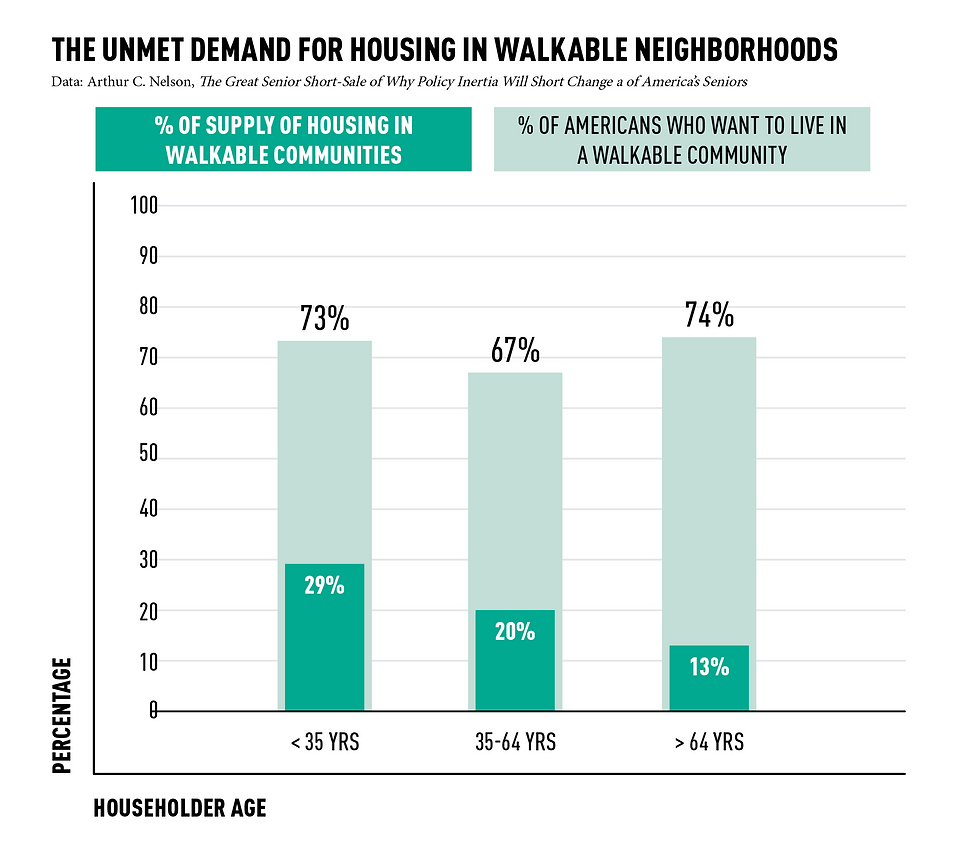
UNMET DEMAND
A majority of individuals—across all age groups—want to live in walkable communities. The problem is, less than 10% of housing stock is located in walkable neighborhoods. This creates increased demand for a small amount of neighborhoods, which further drives up home prices in these desirable areas.
We like to say: it’s not a shortage of walkable neighborhoods, but a shortage of housing in walkable neighborhoods.
We have an oversupply of large single family homes, and a deficit of small format housing choices.
We need to build more housing that matches our current needs:
small, attainable, and in walkable neighborhoods.

THE VARIABLES
IRC vs. IBC
Understanding the distinction between the IRC and IBC is crucial for creating successful, responsible, and attainable housing choice.
The IRC (International Residential Code) includes single-family, duplexes, townhomes, and accessory structures no more than three stories above grade.
The IBC (International Building Code) includes multifamily (3+ units), commercial, and mixed-use buildings. Both the IRC and IBC are comprehensive codes designed for specific building types, differing in the requirements and scope needed.
The IBC triggers much more stringent, and therefore expensive, requirements: sprinkler and fire alarm systems, engineering requirements, elevators, accessibility requirements, etc. Small IBC buildings are frequently non-viable—even at luxury rents—due to these costly requirements.
Understanding these thresholds can prevent costly design choices. For example, take two designs for the same plot pictured below. Both create 4 units of housing, but by designing with IRC/IBC thresholds in mind, the townhome design on the left falls under IRC, which leads both to construction savings and the ability to be sold fee-simple.


HOME OWNERSHIP or ATTAINABLE RENTAL
Next up, we need to determine the ownership goals for your project: Are we promoting homeownership, increasing rental attainability, or both? If homeownership is the primary goal, we often focus on adorable IRC (International Residential Code) cottages that can be built and sold fee-simple—fingers crossed that local subdivision ordinances allow it! For rental projects, we can certainly deploy those charming cottages, but we also have a treasure trove of “missing middle” housing options. These include two- and three-story walkup buildings—what we lovingly call our “plexes.” Whether it’s fourplexes, sixplexes, or even twelveplexes, these designs are versatile and effective in meeting the diverse housing needs of our communities. Plexes must conform to IBC (International Building Code) in a majority of jurisdictions. This is a more complex set of requirements that results in a more expensive building, but the additional units provided often makes up for the extra work.
WE BELIEVE IN
For KUA, expanding housing choice means
expanding housing variety.
This means providing more housing at a
variety of price points in walkable neighborhoods.
It means a
variety of housing styles and sizes.
homeownership
that is more
atttainable.
It means a
variety of rental options
that are more affordable and
OUR APPROACH
HOUSING CHOICE CATALOGUE
We’ve put in years of hard work refining our Housing Choice Companion- a catalogue of small-format cottages that come as singles, two-packs, and four-packs. These structures are designed to nestle together on larger sites, forming delightful cottage courts, typically at a density of 12-18 units per acre. Think of them as the adorable puppies of the housing world—simple, cute, and easy to build, with good porches that invite community interaction. We design these cottages with 2-foot construction intervals and incorporate a variety of effective practices taught in our Incremental Development classes. This step is crucial because our refined catalogue allows clients to explore our Housing Choice Companion and select their preferred units in advance.

ATTAINABLE CONSTRUCTION
Another invaluable resource in our toolkit is our stock cottage and “plex” construction documents library. This allows us to provide attainable construction drawings based on finished products. The designs are intentionally straightforward and familiar, making them fit seamlessly into most communities. We can easily modify them to comply with local building codes and aesthetics—whether it’s tweaking porches, exterior finishes, or trim to ensure compatibility. Sure, there are costs associated with these modifications, but when our base design fees are reasonable, the math tends to work out favorably. It’s a win-win situation for everyone involved!
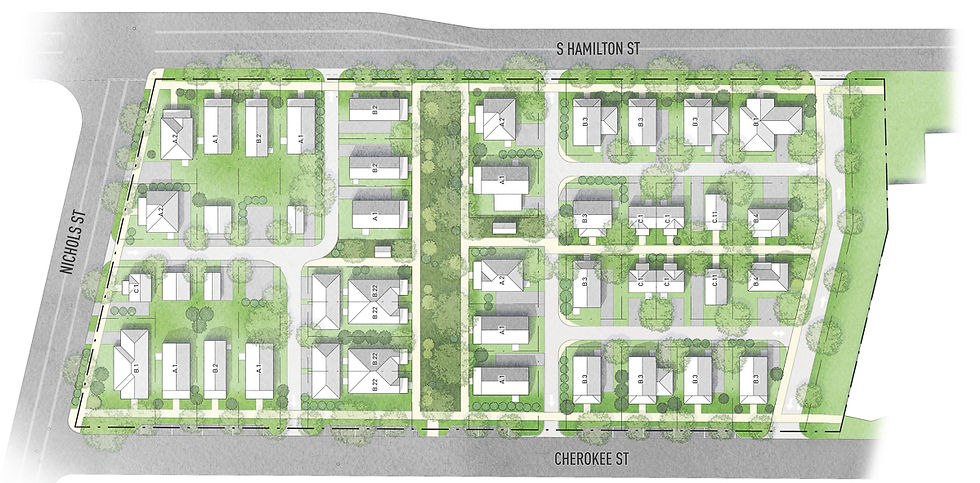
SITE STUDIES
WORK WITH US
By adding more housing options, we are not just addressing a crisis; we are fostering communities where diversity flourishes and where every resident has the opportunity to thrive. Housing is a fundamental right, and it is our duty as architects and urban designers to champion solutions that dismantle barriers and promote equity.
So let’s embark on this journey together! Reach out to us, and let’s explore how we can harness our combined passions and expertise to create housing solutions that truly make a difference. After all, the goal is to ensure that everyone has a place to call home—a place that reflects their identity and nurtures their aspirations.
Together, we can reshape our neighborhoods, making them more accessible and attainable for all. Here’s to building a future where every community member can find their place in a vibrant, diverse, and equitable landscape.
Let’s connect and make it happen!